May 14, 2026
Jared Auld




Why Most Exhibitors Lose Money After Trade Shows (And How to Fix It)
Trade show season is supposed to be a money maker. But for most companies, it's the opposite.
Here's the pattern we see over and over:
A company spends $50K, $100K, or more on a trade show booth. They get leads. Maybe a hundred of them. Maybe five hundred.
And then nothing happens.
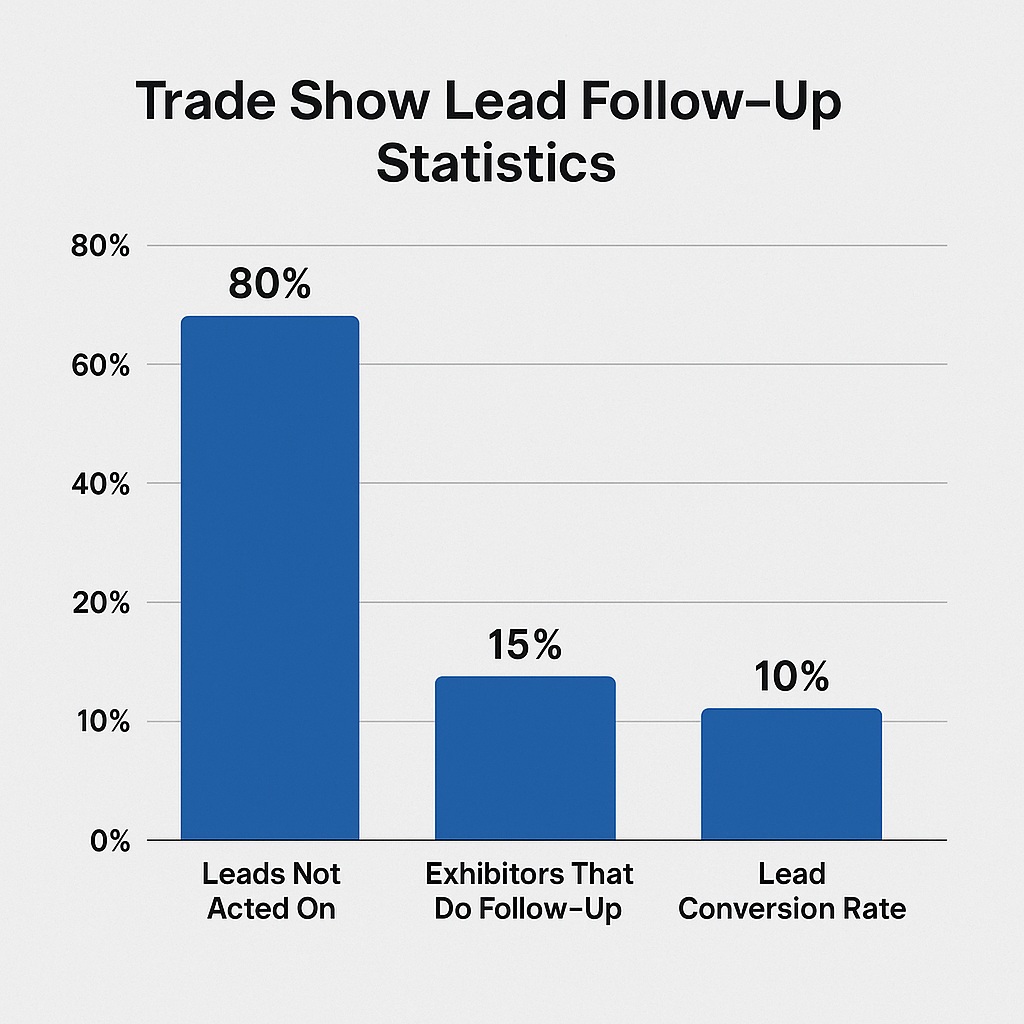
The leads sit in a spreadsheet. The sales team gets busy with existing deals. Two weeks after the show, someone finally reaches out to the leads. By then, attendees have moved on. They've talked to five other vendors. They don't remember who was who.
Three months later, the company looks at their pipeline and realizes: we spent $100K at that trade show and closed two deals.
In other words, we lost $50K per deal. And the worst part? We'll probably do the exact same thing next year.
The Real Problem Isn't the Trade Show
Trade shows are actually an incredible opportunity. Where else can you have face-to-face conversations with hundreds of qualified prospects in a single weekend?
But the real money is made in what happens after the show. And that's where most companies fail.
Why? Because their follow-up process is broken.
A typical post-trade show workflow looks like this:
1. Sales rep talks to a prospect at the booth.
2. Sales rep takes notes on a piece of paper or types into a CRM on their phone.
3. Rep goes back to the office and manually enters the lead into the system.
4. Rep forgets what they talked about or enters incomplete information.
5. Rep doesn't know what the next step is.
6. Lead goes cold.
The friction is everywhere. And where there's friction, deals die.
What Qord Brings to Trade Shows
Imagine if the process worked differently:
1. Sales rep talks to prospect at booth. During conversation, they capture key details using voice notes or quick text.
2. AI immediately captures context - who they are, what they do, what problem they have.
3. At the end of the day, the rep has a ready-to-send personalized email for each prospect, with the conversation details already captured.
4. The follow-up email goes out within 24 hours - while the prospect still remembers the conversation.
5. When the prospect replies, the rep knows exactly what to say next because context is already there.
The Math on This Is Brutal
Let's say your trade show costs $100K. You get 300 qualified leads.
Right now, you might close 2-3 of those deals. That's $33-50K per closed deal.
But what if you captured the conversation properly? What if you followed up within 24 hours? What if every rep knew exactly what to say in that first follow-up?
Industry benchmarks suggest that immediate follow-up with context can increase trade show ROI by 300-400%.
That same $100K trade show could now close 8-10 deals instead of 2-3.
Suddenly your cost per deal is $10-12K instead of $40K.
The difference is execution, not the trade show itself.
Why Most Companies Fail at Post-Show Follow-Up
There are three reasons:
1. Information Loss
A sales rep talks to 10 people at a booth. They remember details about maybe three of them clearly. The other seven? The notes are vague or missing altogether.
Without context, the rep has no idea what to say in the follow-up email.
2. Time Delay
The rep comes back to the office and spends days processing leads. Meanwhile, the momentum from the show is gone. The prospect has moved on.
3. No Next Step Clarity
Even if the lead is entered correctly, the rep doesn't know what the actual next step should be. Do they schedule a demo? Do they send more information? Do they pass it to someone else?
Without a clear next step, the lead stalls.
How to Fix It
The solution has three parts:
1. Capture Context in Real-Time
Don't wait until the show is over. As you talk to a prospect, capture the key details: Who are they? What's their role? What problem are they trying to solve? What did you promise to send them?
This doesn't have to be a formal CRM entry. It can be as simple as voice notes or quick text. The AI can structure it later.
2. Automate the Initial Follow-Up
Within 24 hours of the show ending, every lead should get a personalized follow-up email. Not a generic "nice to meet you" email. A real email that references what you talked about.
This is where AI makes a huge difference. It can generate personalized follow-up emails based on the notes captured at the booth.
3. Define the Next Step
In every follow-up email, there should be a specific ask. Schedule a demo on Tuesday. Let me send you this resource. Can we set up a time to talk next week?
A clear next step is the difference between a lead that moves forward and one that dies.
The Trade Show ROI You're Leaving on the Table
Most companies are leaving 60-70% of their trade show potential on the table. Not because the show is bad. Not because the leads are bad. But because the follow-up process is broken.
Fix the follow-up, and suddenly those $100K trade shows become money makers instead of money pits.
The companies that figure this out gain a massive competitive advantage. Because their sales team is closing deals from trade show leads while their competitors' leads are still sitting in a spreadsheet.